


How navTokens Work
navTokens are engineered to ourperform their underlying assets. Each navToken is backed by a single-asset reserve. navSOL → Backed by SOLnavBONK → Backed by BONK
navORE → Backed by ORE navTokens are minted in exchange for their reserve asset (e.g., navSOL is minted with SOL). Those reserve assest are deposited into a protocol-owned reserve which fulfills navToken redemptions. Each navToken offers structural price asymmetry against its reserve asset:
- Magnified upside potential
- Mathematically limited downside
- Price rises when people buy (mint).
- Price falls when people sell (redeem), but never below the NAV (floor price).
Rising Floor Price (The NAV)
A navToken’s floor price is a mathematically assured minimum conversion rate that’s always redeemable. The protocol enforces the floor by using its reserves to provide an on-chain bid that’s capable of redeeming every navToken in supply at the floor price. The floor price can rise, but never fall.
- Rebalancing When there is sufficient liquidity above the floor price, the AVM adjusts the price curve, reallocating some liquidity to the floor, raising it higher.
- Fee drip A portion of fees from every buy, sell and borrow within any given market, is directed to the floor reserves, raising the floor price.
Non-liquidating Loans
Samsara offers interest-free loans with no liquidation risk, using any navToken as collateral. deposit navToken → borrow the reserve asset up to the floor value of your collateral. Non-liquidating loans are made possible by the floor price, enabling flexible strategies for holders, including non-liquidating leverage.Governance & Fees
Each navToken market has various parameters and fees that are governed higher or lower by prANA holders. All parameters shift incrementally on a weekly cadence, by the amount indicated in the “change” column below.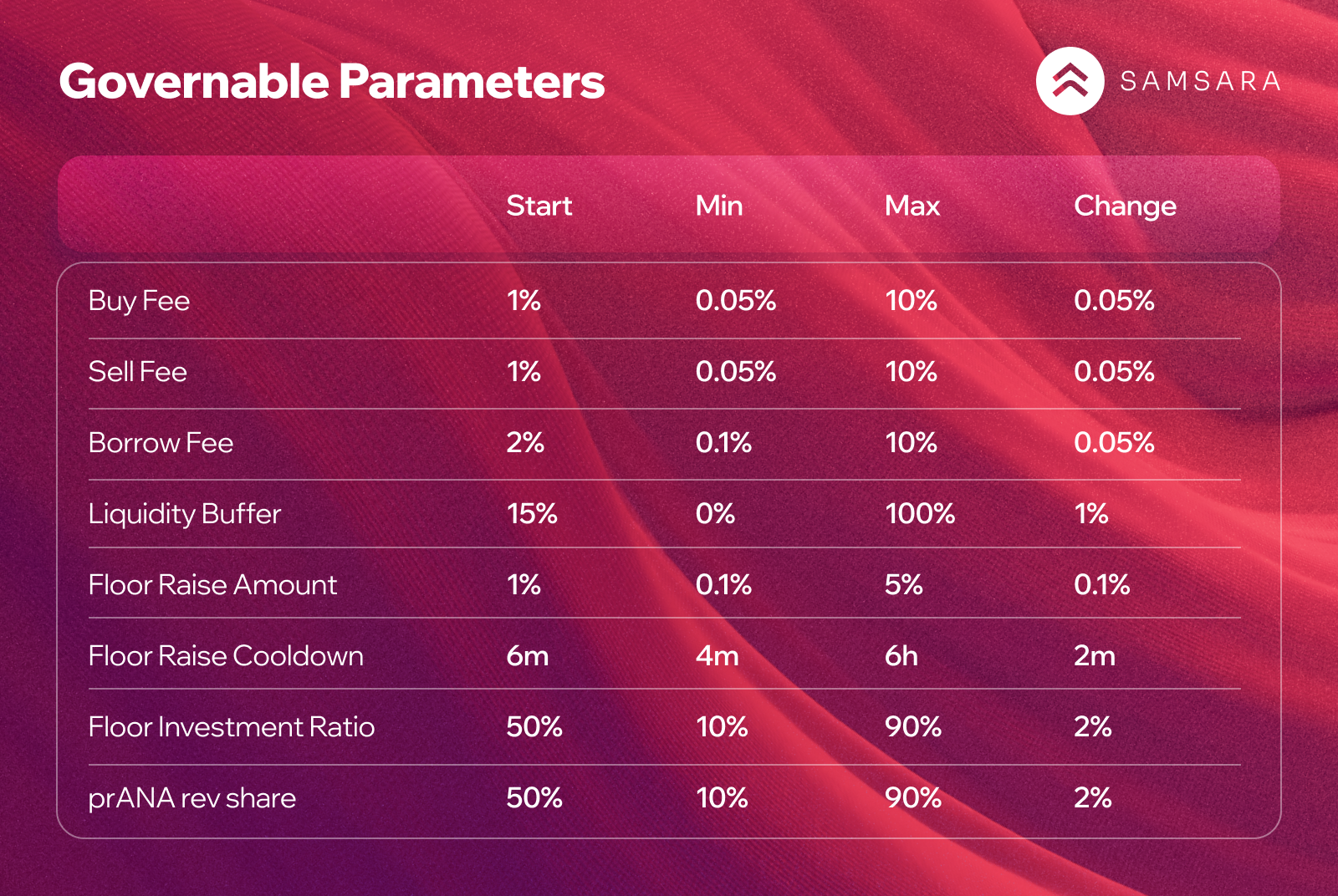
Key Metrics
Samsara’s unique design introduces some new key metrics:
Ascent - The performance mutiple
Ascent tracks the all-time performance of a navToken against its underlying asset.Example: An ascent of 3x for navSOL means that navSOL has outperformed SOL by 3 times (200%). So if navSOL launched at 0.01 SOL, a 3x ascent implies that the price is now 0.03 SOL.
Price
Samsara displays the price of navTokens in terms of both USD and a conversion rate to it’s underlying asset.Floor
The floor is the mathematically assured minimum conversion rate of a navToken to its underlying asset. The floor is always redeemable and solvent, even if everyone redeems their navTokens at once. The top number in this column displays the coverage, which is the percentage of market price protected by the floor price. Since you can borrow agaisnt navTokens up to the floor value, coverage is also idential to your current maximum Loan-to-Value Ratio (LTV).Example: If the market price of navSOL is 0.10 SOL, and the floor price is 0.08 SOL, its coverage would be 80%, therefore the navSOL price cannot drop more than 20% agaisnt SOL. 80% coverage also means you can borrow up to 80% of your SOL depoit back (exluding fees and price impact) interest-free with no liquidation risk.